FAQs

South Africa needs front-of-package warning labels (FoPWL) to help consumers make better choices and live healthier lives. South Africans are consuming more ultra-processed foods that are high in sugar, salt and saturated fat – contributing to the obesity and NCD disease rates.

Understanding what is in the food we eat can be challenging. The nutrition labels (currently on the back of food packaging) are confusing and difficult to understand or comprehend.

Front-of-package warning labels (FOPWL) on foods high in sugar, salt and saturated fat and containing non-sugar sweeteners provide consumers with a quick and easy way to understand what is in their food – helping them make healthier food choices by avoiding these unhealthy food products.¹

FoPWL helps all consumers to easily and quickly understand if a food or drink is unhealthy based on the levels of nutrients of concern.

When South African parents from Limpopo saw images of products with an FOPWL on them they indicated that they would instead buy non-labelled, healthier options.⁶

FoPWL can help parents understand which foods are high in sugar, salt, and saturated fat and allow them to think about the future health impacts if their children continue to eat these foods.

FoPWL can help the public better understand what is in their food and discourage the purchase and consumption of unhealthy, ultra-processed foods.

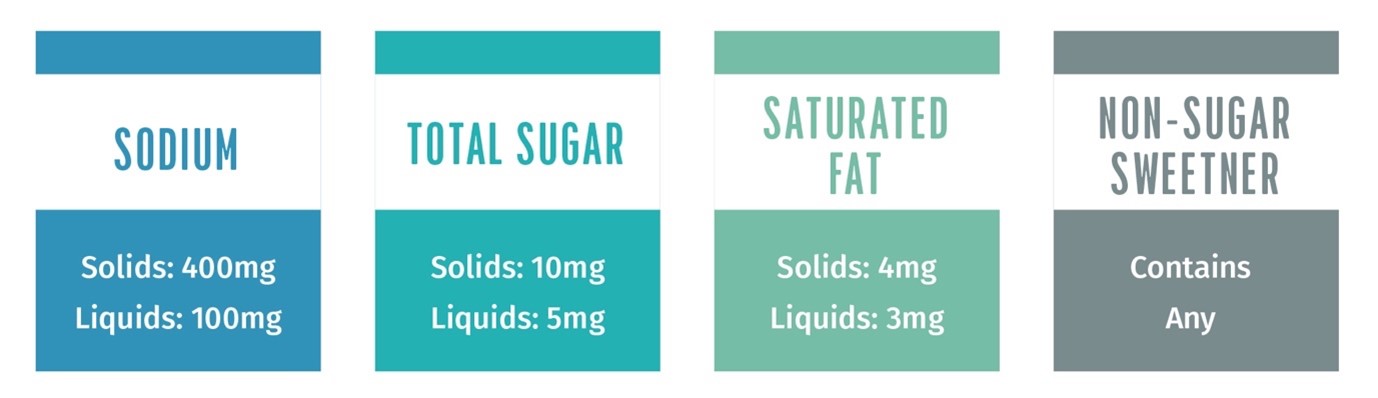
To determine what foods and beverages should have warning labels on them, researchers assessed the nutrients in foods sold in South Africa and developed a nutrient profiling model (NPM) to identify which foods were most unhealthy. This NPM has a strong scientific base and has been tested and applied to the South African context.⁷

All foods and beverages that have added salt, sugar or saturated fat or contain any non-sugar sweetener and fall within certain thresholds should have a FoPWL on them. These are usually packaged, processed or ultra-processed foods.

Several warning labels were designed to be tested on South African consumers.

The proposed triangle warning labels are based on the experiences of other countries, such as Chile, Mexico, Argentina and Peru, which have implemented octagonal warning labels in their food packaging.⁸

These designs were based on literature about effective shapes, text, and icons that would increase South African consumers’ identification of the presence of unhealthy nutrients in foods and encourage healthier choices.


South African consumers found the warning labels attention-grabbing and preferred the following design:
• A black triangle on a white background
• The words “high in” and “warning” in bold and uppercase text
• An exclamation mark
• Icon showing the nutrient of concern (salt, sugar, saturated fat)


#1: Bopape M, De Man J, Taillie LS, Ng SW, Murukutla N, Swart R. Effect of different front-of-package food labels on identification of unhealthy products and intention to purchase the products–A randomised controlled trial in South Africa. Appetite. 2022 Dec 1;179:106283.

#2: Pillay-van Wyk V, Msemburi W, Laubscher R, Dorrington RE, Groenewald P, Glass T, et al. Mortality trends and differentials in South Africa from 1997 to 2012: second National Burden of Disease Study. The Lancet Global Health. 2016 Sep 1;4(9):e642-53.

#3: Statistics South Africa. Mortality and causes of death in SOuth Africa, Findings from death notification. 2017.

#4: National Department of Health (NDoH), Statistics South Africa (Stats SA), South African Medical Research Council (SAMRC), and ICF. 2019. South Africa Demographic and Health Survey 2016. Pretoria, South Africa, and Rockville, Maryland, USA: NDoH, Stats SA, SAMRC, and ICF.

#5: Lobstein T, Brinsden H. 2019. Atlas of Childhood Obesity 2019. London. World Obesity Federation.

#6: Bopape M, Taillie LS, Swart R. Perceived effect of warning label on parental food purchasing and drivers of food selection among South African parents–An exploratory study. Frontiers in public health. 2022;10.

#7: Frank T, Thow AM, Ng SW, Ostrowski J, Bopape M, Swart EC. A fit-for-purpose nutrient profiling model to underpin food and nutrition policies in South Africa. Nutrients. 2021 Jul 28;13(8):2584.

#8: Bopape M, Taillie LS, Frank T, Murukutla N, Cotter T, Majija L, Swart R. South African consumers’ perceptions of front-of-package warning labels on unhealthy foods and drinks.
PloS one. 2021 Sep 27;16(9):e0257626.